The buying recommendation
Start with a dessert bowl sized for the actual yogurt or dessert, including toppings and closure clearance. For producer-filled products, provide the filling and labelling process and ask for candidate availability rather than treating a shop-service sample as production approval.
Separate freshly served desserts, producer-filled products and seasonal artwork decisions.
01 / Buyer guide
Which Products Should Your Business Compare?
Use the project recommendation above to compare the relevant product families below. Add only the sizes and components that fulfil a defined menu or operating role.
Product starting point
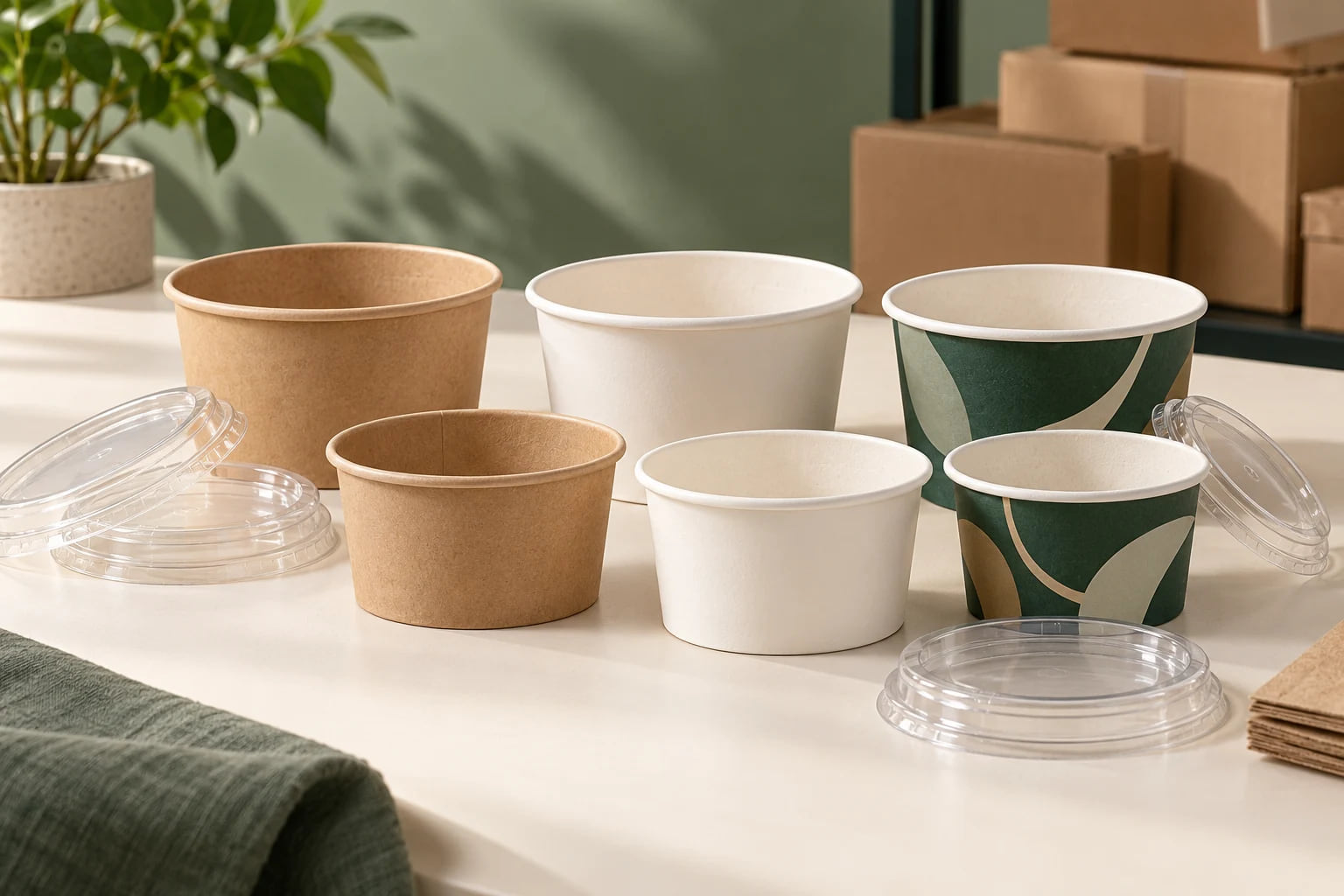
Paper Dessert and Ice-Cream Bowls
Compare the portion actually served, including scoops, sauces and toppings, with usable space beneath any lid.
View the Relevant Product Range ↗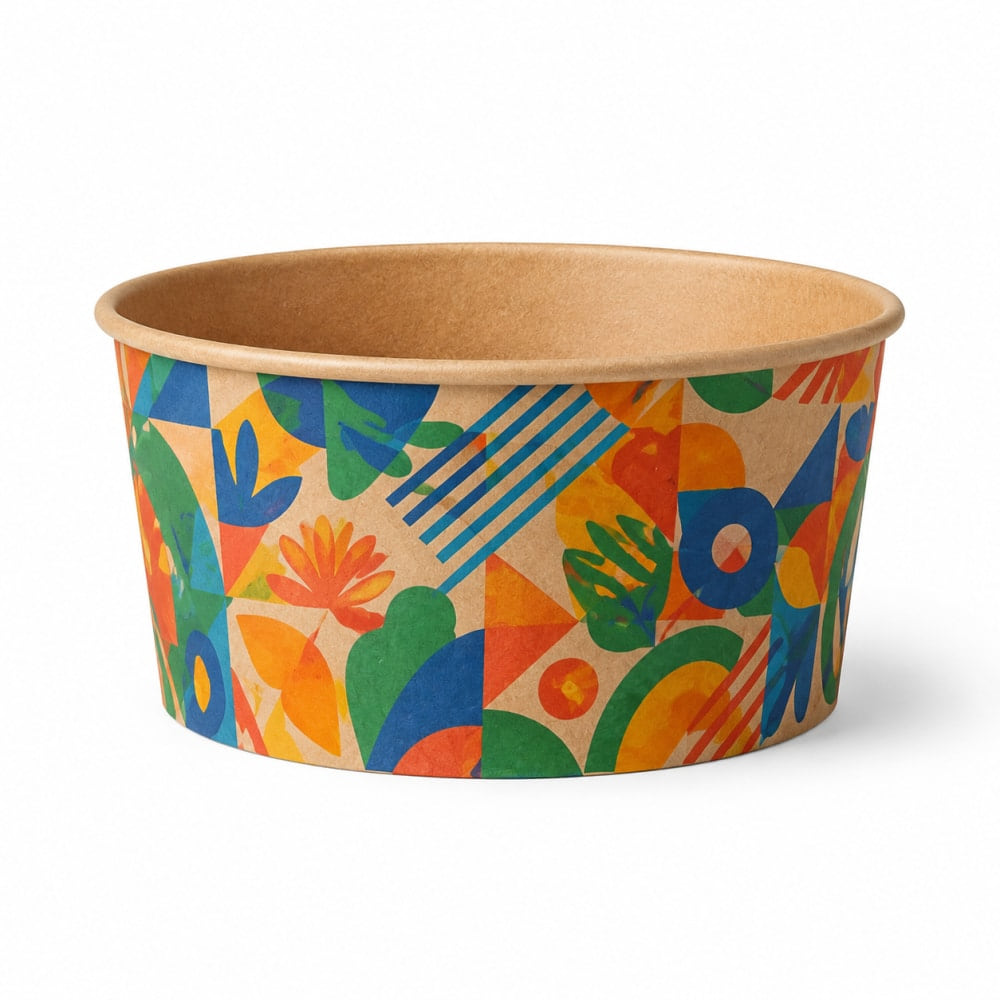
Product starting point
An Appropriate Larger Bowl Format
Consider only where the menu genuinely needs a larger dessert portion; do not assume every salad bowl is a dessert specification.
View the Relevant Product Range ↗Product starting point
The Exact Matched Lid
Include the intended open service or closed carrying arrangement and identify the lid material separately.
View the Relevant Product Range ↗Choose the smallest useful range that covers the intended food and operating needs. Keep each accepted container, closure and artwork reference together so repeat quotations describe the same pack.
02 / Buyer guide
What Makes This a Good Paper Pack?
Dessert packaging needs to fit the served portion and its toppings while supporting the way the brand sells. A shop serving freshly scooped ice cream, a producer filling yogurt and a chain launching a seasonal design have different approval and purchasing priorities.
| Quality factor | What to inspect |
|---|---|
| Scoop and topping clearance | Assess the tallest assembled serving rather than the empty bowl’s stated volume. |
| Melting and wet contact | Check the normal product and service period for staining, softening and seam performance. |
| Eating and handling | Review rim comfort, spoon access and the loaded cup’s stability during normal use. |
| Cold-service print | Inspect the selected print surface with condensation and handling where relevant. |
Checks for This Specific Project.
Filling Route
Trial the actual manual or equipment-assisted filling process.
Product Contact
Inspect the finished dessert through its intended service or qualified holding routine.
Information Space
Review where permanent graphics and changing product information can coexist.
Compare candidates with the same agreed food, portion and handling conditions. Keep photographs, sample identities and observations with the decision; turn the accepted result into a written purchasing reference.
03 / Buyer guide
Use Stock, Labels or Custom Print?
| Buying route | When it fits this project | What to compare |
|---|---|---|
| Plain / stock-format enquiry | Useful for early product and filling trials. | Less dedicated artwork inventory; confirm availability and order terms. Buyer branding may be less visible. |
| Plain + buyer-applied label | Useful where recipes or product information change frequently on one approved structure. | Flexible information, with additional label purchasing, application work and surface checks. |
| Custom print on an existing format | Choose permanent brand printing once the pack and filling route are stable. | A recurring brand identity with artwork/proofing work and quantities planned by size and design. |
| New structure / tooling enquiry | A production closure or equipment need may justify development, subject to separate qualification. | A functional development decision with samples, qualification and a separate commercial proposal. |
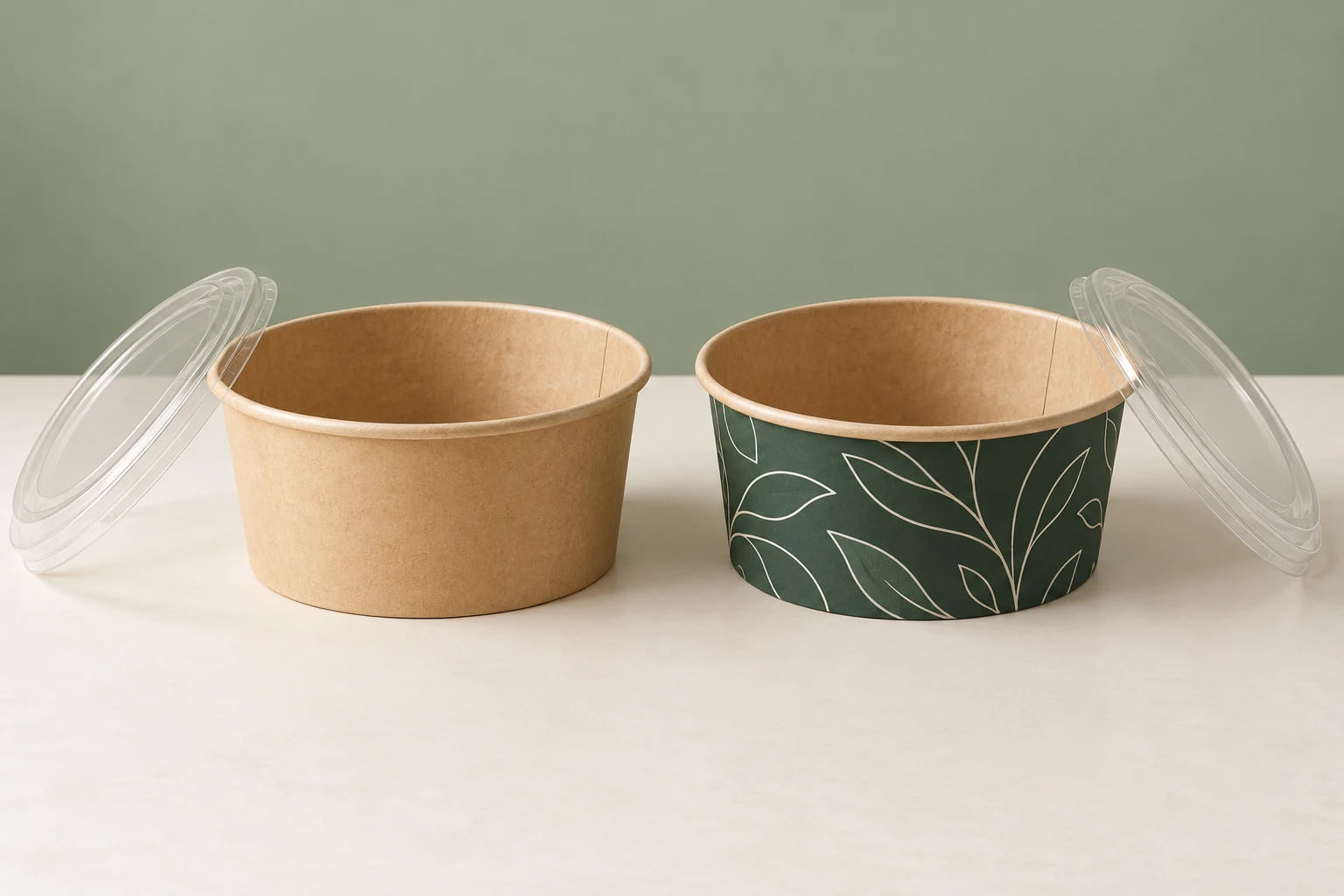
What Custom Printing Can Do for the Business.
A Visible Dessert Identity
Custom artwork can make a small cup recognisable across branches and takeaway orders.
A Coordinated Portion Family
Scaling the brand design across approved serving sizes can create a consistent menu presentation.
A Planned Seasonal Programme
Permanent and campaign designs can be separated deliberately instead of leaving unplanned printed stock.
Compare the Whole Purchasing Decision.
Request comparable quotes for the same structure and use. Include artwork and proofing charges, quantity per size/design, labels and application work, carton units, delivery scope and unused printed stock. Custom print creates value when recognition and repeat demand justify those commitments; it is not an automatic saving.
04 / Buyer guide
Choose the Board, Barrier and Closure Separately.
Compare moisture-barrier dessert structures using the actual product and holding conditions. Choose a white or natural exterior by artwork and sample appearance. Factory filling, sealed distribution and chilled shelf life require exact-pack process evidence beyond a dessert-cup listing.
| Application component | Recommended starting point |
|---|---|
| Moisture-barrier paper | Use a finished structure suitable for the intended dessert contact, not an unverified dry-paper cup. |
| White or natural kraft exterior | Choose around the desired artwork and appearance; review the printed proof on the actual surface. |
| Lid and topping profile | A different lid height or material requires its own approval, even if the cup looks unchanged. |
| Frozen storage | Treat frozen distribution as a separate qualification project, not a consequence of the ice-cream product name. |
| Route | Why compare it | What needs confirmation |
|---|---|---|
| Natural kraft exterior | A useful starting look for restrained graphics and a visible natural-paper finish. | Review real print contrast and consistency. Kraft colour is not a barrier specification or environmental certification. |
| White exterior / print surface | Compare when fine detail, colour appearance or a clean visual system is central to the brand. | Approve a proof on the actual finished surface; exterior colour does not establish food-contact performance. |
| PE-lined finished pack | A practical comparison baseline where offered for the intended wet/oily food or beverage. | Confirm the exact construction, food-contact use and paired closure. Recycling acceptance depends on the finished pack and local system. |
| Dispersion / alternative barrier | Worth comparing when a specific material or end-of-life brief motivates an alternative. | Availability and properties depend on the finished structure. Obtain candidate-specific information and trial it; do not assume a universal replacement. |
| PLA or a compostability-led route | Consider only where that exact candidate and a relevant collection route are available. | Check the complete product and any certification scope. A polymer name does not establish home compostability or local acceptance. |
| Separate lid or integral closure | Choose around food height, visibility, closure and the real service routine. | Record lid material and reference separately. Matching diameter alone does not guarantee compatibility. |
Material background: Metsä Board foodservice boards explains board and barrier roles; Stora Enso barrier solutions describes product-specific alternatives. These are material references, not evidence of Fude using those suppliers or grades. For compostability-led enquiries, verify the exact product in the relevant certification directory and collection system.
PET, PP or Paper/Fibre for the Lid?
For freshly served cold desserts, compare clear flat and dome candidates against topping height and visibility. PET can be a cold-service comparison route; PP or paper/fibre alternatives should be assessed as exact offered products. Open service may need no lid at all.
| Lid route | Why compare it | Trade-off and check |
|---|---|---|
| PET lid | Compare for cold-food visibility and a clear display. | Check the actual product’s use limitations, headspace and rim pairing. Do not transfer a cold-use approval to hot food or heating. |
| PP lid | Compare where an offered grade and finished design suit the intended handling or thermal brief. | Inspect clarity, stiffness, fit and exact-use evidence. The letters PP do not approve every lid for every appliance. |
| Paper / moulded-fibre lid | Compare for a coordinated paper-led appearance. | Usually gives less product visibility; assess barrier, condensation, fit and any window separately. Fibre content alone does not establish compostability. |
For examples of product-specific use differences, see BioPak’s cold-use PET lid and specified paper bowl lid. These examples illustrate why finished-product specifications matter; they do not describe Fude lid availability or approval.
05 / Buyer guide
How to Choose a Capable Manufacturer.
Ask which candidate fits the stated shop-filled or producer-filled brief and what information is needed for the next validation step.
| Manufacturer question | Useful answer or evidence |
|---|---|
| Can the actual dessert be trialled? | Use the serving height, sauce and carrying routine in sample approval. |
| Which lid fits each proposed bowl? | Request paired references and verify clearance. |
| How will small and seasonal artwork runs be quoted? | Confirm quantities for each printed size/design and any proofing charges. |
Relevant Manufacturing Scope
Ask which operations and products are offered directly and which components or processes involve other suppliers. A broad catalogue alone does not establish control of every proposed item.
A Traceable Approval Route
Look for an agreed specification, sample identity, correct dieline, artwork revision and authorised approver. Relevant product information should describe the exact structure and intended use.
A Clear Repeat-Order and Issue Process
Agree how ordered references, packing and batch information are identified, how discrepancies are reported and how substitutions or changes are approved before production.
06 / Buyer guide
Send a Brief That Produces Comparable Proposals.
Using one quotation description for both freshly served yogurt and a prepacked retail dessert hides important closure and holding differences.
Define the Product and Food.
Include portions, food photographs, moisture/oil contact, the intended closure and the real filling, holding and carrying routine. State special equipment, storage or heating only where part of the actual project.
Separate Quantities and Identities.
List quantity per size and artwork, distinguish forecast from firm order and identify the authorised design owner. Share the receiving point and required timing, then ask for a project-specific proposal.
Agree Acceptance Before the Bulk Order.
Confirm sample checks, relevant document scope, carton units, production reference and change approval. Ask for MOQ, proofing costs and timing for the quoted combination rather than assuming a universal figure.
An enquiry you can adapt
We are developing branded paper dessert packaging for the attached product. Our brief identifies the filling site, method, portion, closure and intended holding route. Please confirm candidate availability, material structure and sample options. Quote the permanent print separately from development work and variable labelling.
07 / Buyer guide
Why Put FUDE on Your Sourcing Shortlist?
Fude is a relevant manufacturer to approach when your brief overlaps its paper cup, bowl, meal-box or food-tray catalogue and custom-packaging service.
For ice cream, yogurt and dessert brands, begin with the product references shown above and ask Fude to propose the exact available structure, paired components and sample route. Compare that response with the guide’s selection criteria rather than choosing on the logo or unit price alone.
Fude’s dessert-bowl catalogue is a starting range, not proof of frozen shelf life, industrial filling-line compatibility or every lid variant.
Ask Fude to confirm dimensions, materials, available customisation, sample/proofing sequence, quantities, timing and delivery responsibilities for your order. Keep the accepted specification and commercial scope in writing.
08 / Buyer guide
Questions Procurement Teams Ask.
Can Shop and Factory Products Share a Cup?
Only after both intended processes are reviewed for the exact pack. Visual similarity alone does not establish compatibility.
Should Changing Flavours Be Printed on the Base Cup?
Compare a permanent brand base with variable flavour labels against separate printed versions and their stock implications.
What Makes Plain and Printed Quotations Comparable?
Use the same product construction, matched closure, quantities and delivery scope. Itemise print/proofing work, labels where relevant and any development separately.
Which Details Are Needed for the First Manufacturer Enquiry?
Provide the menu and portions, intended use, products and lids, quantities by size/design, destination, timing and sample requirements. Use the scenario brief above as a starting point.
Your manufacturer-ready enquiry
Turn This Guide into a Useful Brief.
Enter your phone number with calling code, email and message, then choose Send Enquiry to submit directly to FUDE through Zoho Forms. Your name is optional.
Continue Your Buying Decision