Partition Layout
Specify which food goes in each area and the relative portion. Confirm actual internal dimensions and divider attachment.

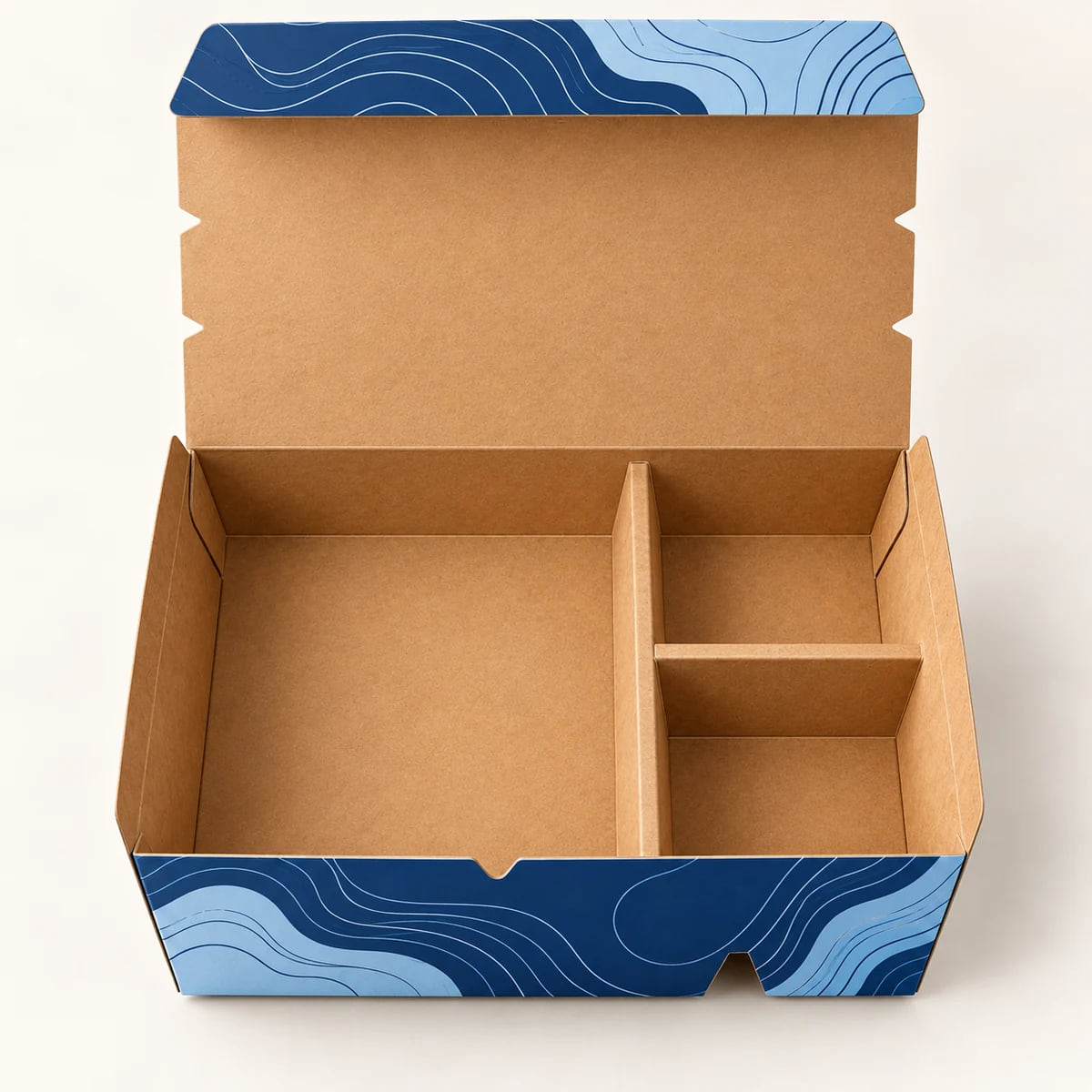
Source 3-compartment meal boxes from Fude Packaging in Shandong, China. Review the exact partition drawing, filled meal layout, divider attachment and closure with your artwork and packing brief for bulk custom orders.
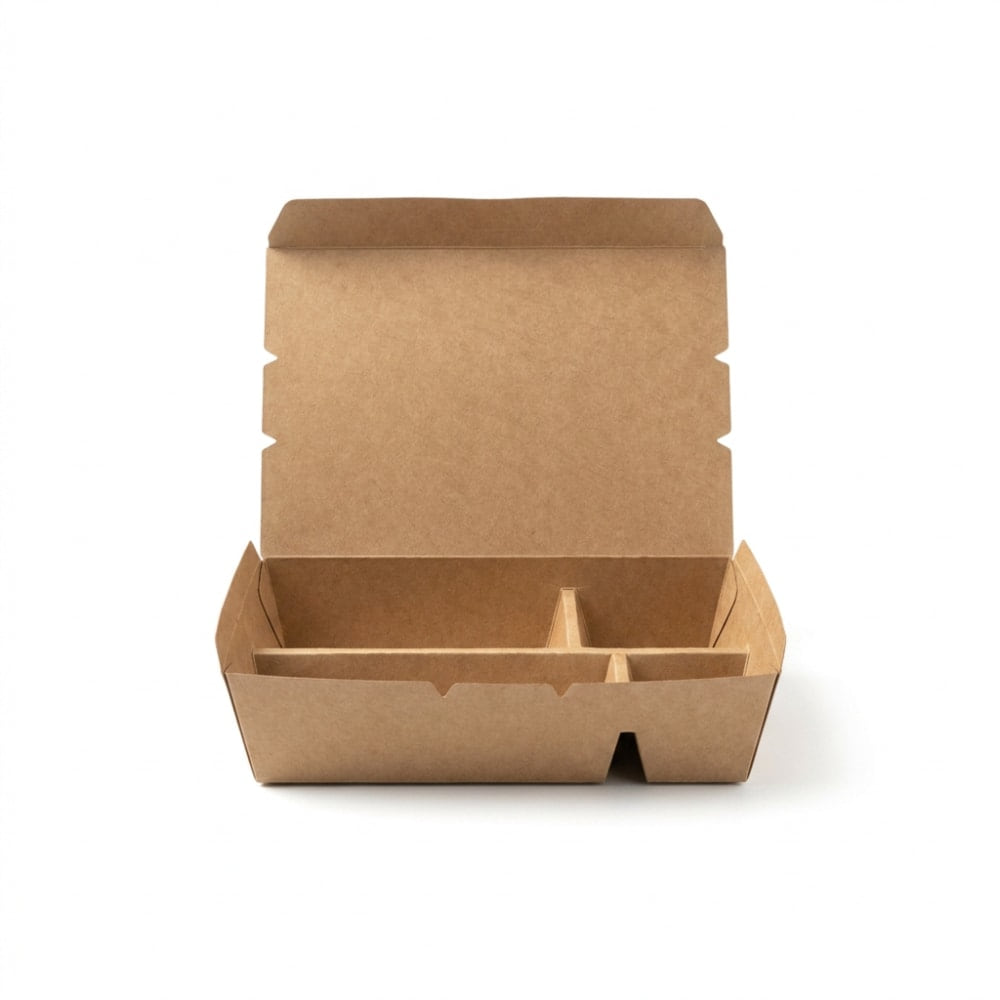
Partitions organize a meal into separate serving areas. The number of compartments does not describe individual portion sizes, divider height or resistance to liquid migration. Those details need a layout drawing and filled-pack review.
Specify which food goes in each area and the relative portion. Confirm actual internal dimensions and divider attachment.
Review the closure, carrying footprint and loaded base. Adding partitions does not establish a secure lid or transport rating.
Describe sauces and food temperatures. Physical separation of solids is different from tested liquid isolation.
The source photo is a structural reference and does not independently verify every divider. Confirm the arrangement on a drawing and loaded sample.
Compare the source catalog references, then approve the current drawing, material build and packing with your quotation. Dimensions are preserved in their original field order.
| Model | Material | Size (cm) | Packaging (pcs/ctn) | Case Size (cm) | Inner Packing |
|---|---|---|---|---|---|
| 337g Kraft Paper | 30 × 18.5 × 5.5 | 200 | 50.5 × 45.5 × 46 | 50 pcs/bag |
*The column labels and values follow the source first table. Paper labels such as “300g” are not reinterpreted as a verified total material build. “50 bags” is not rewritten as 50 pieces per bag.
The first tables on 4- and 5-compartment source pages repeat 2- and 3-compartment rows. Their pictures also do not establish the requested counts. Only exact 2/3 rows can be used as references; 4/5 remain configuration-review pages.
Uses the selected reference row. Cartons round up; the order quantity and MOQ are confirmed separately. Excludes pallets, loading gaps, freight and any separately packed lids. Volume is shown only where the source explicitly labels carton dimensions in cm.
The first table includes one named three-compartment row. Map your main, grain and side to the actual layout before approving the configuration.
| Model | Material | Size (cm) | Packaging (pcs/ctn) | Case Size (cm) | Inner Packing |
|---|---|---|---|---|---|
| 2-Compartment 2000ml | 337g Kraft Paper | 21.2 × 16 × 6.2 | 200 | 55.5 × 34 × 47 | 50 pcs/bag |
| 2-Compartment 1400ml | 337g Kraft Paper | 17.2 × 13.8 × 6.5 | 300 | 59.5 × 39.5 × 46 | 50 pcs/bag |
| 2-Compartment 1080ml | 337g Kraft Paper | 17 × 13.5 × 4.8 | 300 | 50.5 × 36 × 44.5 | 50 pcs/bag |
| 3-Compartment Lunch Box · this page | 337g Kraft Paper | 30 × 18.5 × 5.5 | 200 | 50.5 × 45.5 × 46 | 50 pcs/bag |
The source photo is a structural reference and does not independently verify every divider. Confirm the arrangement on a drawing and loaded sample. Identical packing listings do not prove identical freight cost or product performance; current printed packing must still be confirmed.
Compare the physical packaging decision and complete served-pack cost. This is a construction and procurement comparison, not a certified performance ranking.
| Buying question | Compartment box | Single-cavity lunch box | Bowl and separate sides |
|---|---|---|---|
| Portion organization | Dividers provide separate solid-food areas | One continuous serving area | Separate packs can allocate portions |
| Drawing requirement | Each compartment and divider height | Base, sidewall and closure | Each bowl, cover and side pack |
| Liquid separation | Must be evaluated; not implied by partitions | No internal partition | Check closure of every pack |
| Menu flexibility | Fixed layout needs portion matching | More freedom within one cavity | Multiple SKUs to coordinate |
| Order record | Exact count and structural drawing | Exact box size and closure | Coordinated pack list and quantities |
Sample review first. Confirm the exact partition drawing, filled meal layout, divider attachment and closure before agreeing to a bulk production run.
Use the actual menu, filling process and handling route to prepare a custom-order brief. These are intended buying scenarios, not named customer endorsements.
Arrange the main, rice or grain and sides using a real menu. Confirm portion balance and closure clearance on a filled sample.
Define meal preparation, holding and carrying steps. Review the full container layout and dispatch pack before setting repeat quantities.
Keep each partition count, exact size and artwork in a distinct record. Do not treat a multi-model table as proof of every requested layout.
Choose an application to include it in the inquiry.
Fude Packaging is a paper food packaging manufacturer in Shandong, China. Review the physical pack, print file and packing together. Custom-order minimums are 50,000 or 100,000 pieces, confirmed per specification and artwork.
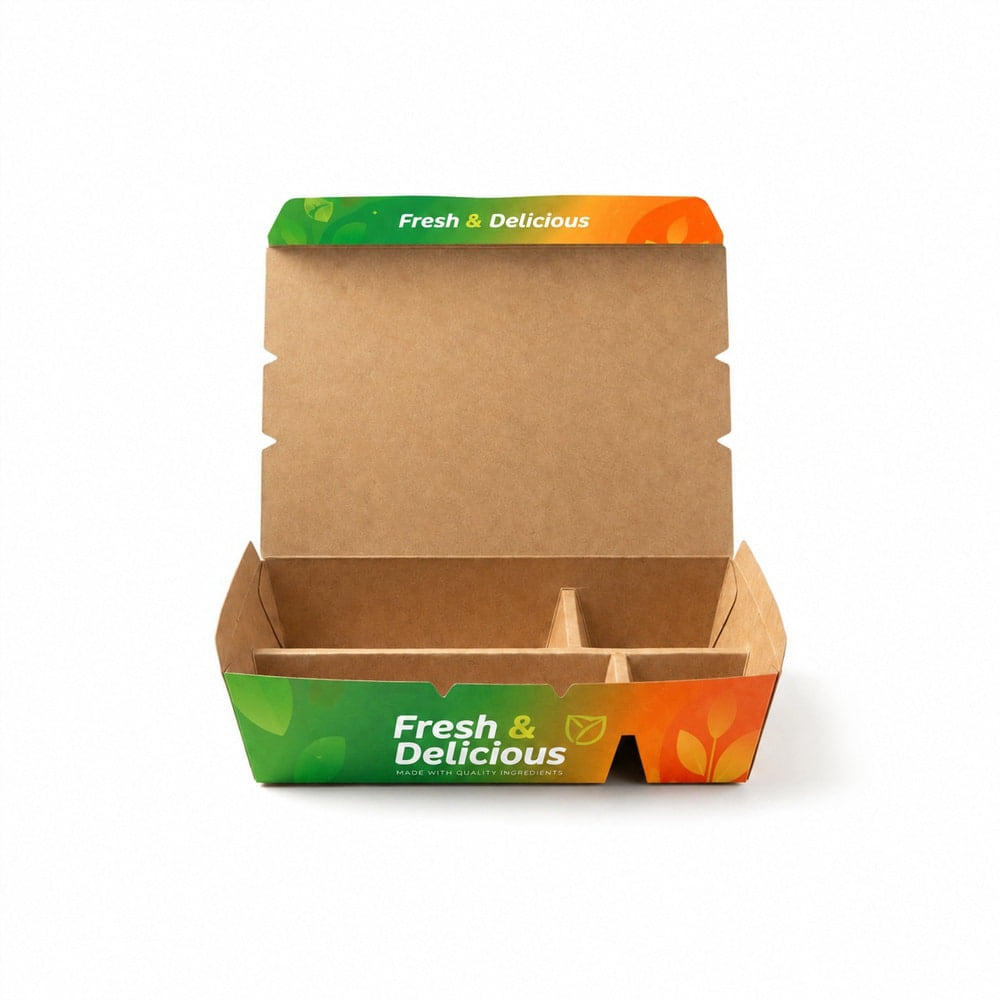
Existing compartment-box structure reference; the photograph does not independently verify this partition count. Confirm the exact layout on a drawing. Printing methods and timing are confirmed in the quotation.
State the required count and food allocation. Request the proposed layout and divider details before treating a model as available.
Agree artwork on the box exterior, lid or other actual printable panels. Review folds and locking areas on the structural dieline.
Evaluate the filled meal and carton packing. Confirm per-configuration quantities, artwork revisions and supply terms.
Market notes help prepare a purchasing brief. They do not represent local inventory, an overseas office or automatic regulatory compliance.
State the exact country and state or province, nominal size and required working volume. Share importer document requests and the port or postcode. Confirm oz labels against the actual intended use.
For this selection, also confirm the exact partition drawing, filled meal layout, divider attachment and closure.
Name the specific importing country and artwork languages. Share working-volume needs and product-specific food-contact document requests. Review any environmental wording against the quoted construction.
For this selection, also confirm the exact partition drawing, filled meal layout, divider attachment and closure.
State the country and state or region, portion or working fill and lid / closure needs. If disposal claims are requested, identify the wording, supporting evidence and intended collection route.
For this selection, also confirm the exact partition drawing, filled meal layout, divider attachment and closure.
Specify the destination country and port. Share English or Arabic artwork needs, importer document requests and the storage or distribution route. Agree packing and delivery terms in the quotation.
For this selection, also confirm the exact partition drawing, filled meal layout, divider attachment and closure.
Select a destination to include it in the inquiry.
A catalog table starts the comparison. Approve the actual proposed sample and drawing for the food, artwork and destination requirements.
Evaluate the exact partition drawing, filled meal layout, divider attachment and closure. Agree the test method and acceptance criteria for the proposed sample.
Check actual dimensions, construction, lid or closure and any partitions as a complete pack.
Review color, print position, marks and packing against a controlled sample and artwork version.
Practical selection and custom-order questions for 3-compartment meal boxes — custom catering oem.
The first table includes one named three-compartment row. Map your main, grain and side to the actual layout before approving the configuration.
The first tables on 4- and 5-compartment source pages repeat 2- and 3-compartment rows. Their pictures also do not establish the requested counts. Only exact 2/3 rows can be used as references; 4/5 remain configuration-review pages.
Custom-order minimums are 50,000 or 100,000 pieces, depending on the specification and artwork. Confirm the applicable minimum separately for each size, material and design; do not assume a combined total across SKUs qualifies.
List every required part in the inquiry. Inclusion, compatibility, material and packing are confirmed separately for the actual configuration. A pictured cover or similarly named model does not guarantee interchangeability.
Only approve claims supported by the exact material, product evidence and destination conditions. Kraft or paper appearance does not prove recyclability, compostability, heat resistance or leak performance.
Ask which existing or custom samples can be supplied, what the charges cover and what the sample represents. Agree the drawing, artwork proof and acceptance process before bulk production.
List quantity by model and artwork. Include the actual food or beverage, closure, destination and arrival needs so the team can review the specification.
Reference selection; specification and applicable MOQ to confirm.
Continue by product evidence, application or procurement program. The same physical specification may support more than one menu.
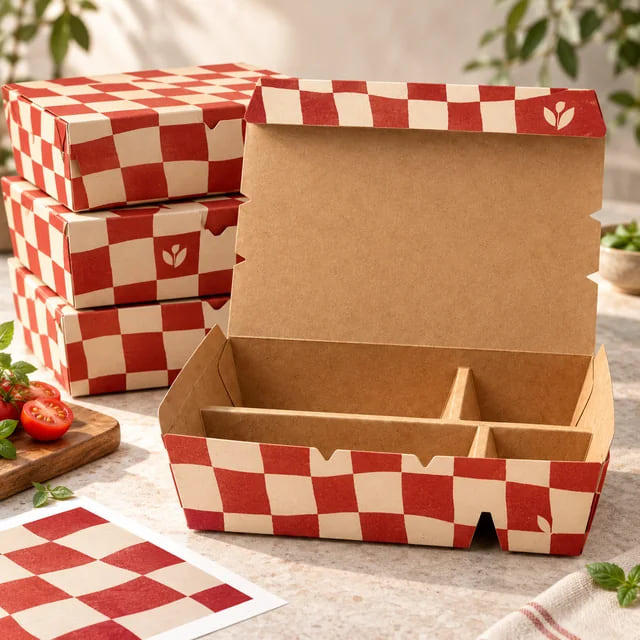 Product × application · custom OEM
Catering brands, contract-foodservice buyers and meal-pack importers
Explore the Buying Specification ↗Move from your buying brief to the product formats and specifications worth reviewing.
These entries describe requested configurations. A verified structure or dimensional specification has not been established. Review the proposed drawing and physical sample before considering supply.
Against 2-Compartment 2000ml, the source lists changes in Size (cm), Case Size (cm). The following listings are the same: Material, Packaging (pcs/ctn), Inner Packing.